
When a business announces automation, the people doing the work often hear something very different from the people buying it. A manager hears “more capacity”. An employee may hear “less security”. Ignoring that difference makes change harder.
There is no honest way to promise that AI will protect every job. There is also no sound reason to treat every exposed task as an entire job that will disappear. Both shortcuts hide the decisions businesses still have to make.
Look at tasks before titles
The ILO–NASK 2025 assessment estimates that occupations with some generative-AI exposure account for 25% of global employment and 34% in high-income countries. The research measures potential exposure; it is not a forecast of layoffs. ILO explanation and methodology.
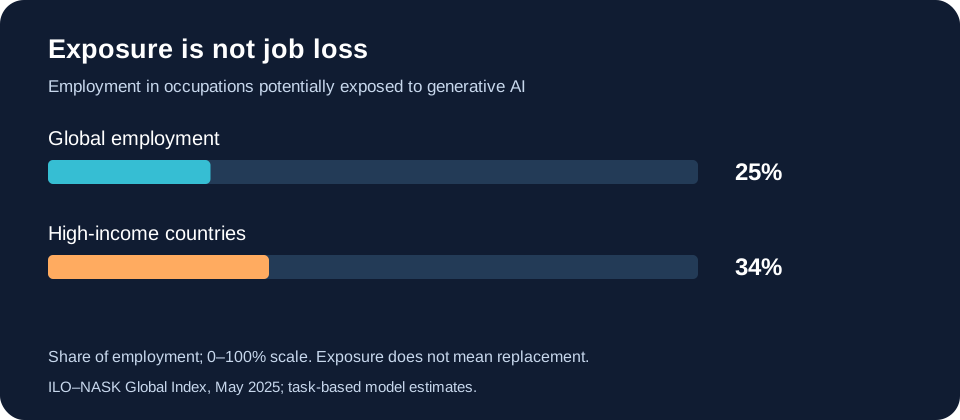
Read the chart values
| Measure | Value |
|---|---|
| Global employment | 25% |
| High-income countries | 34% |
Consider a customer-care role. Recording a conversation, preparing a draft and finding a policy may be supported by software. Understanding an upset customer, deciding when to escalate and taking responsibility for the response are different parts of the job.
Even where a task becomes faster, someone needs to decide how the time is used. A business might improve response quality, serve more customers, change staffing or make a mixture of those choices. Technology alone does not choose the outcome.
New responsibilities need real training
“Use AI” is not a training plan. People need to know which information they can share, what they must check and when to stop. They should practise with ordinary cases and with exceptions, including the uncomfortable ones that do not fit the workflow.
- Review: can the employee spot an unsupported answer?
- Ownership: who approves a message before it reaches a customer?
- Escalation: where does a sensitive or unusual case go?
- Learning: can the team report a problem without being blamed for it?
These responsibilities may create opportunities in workflow coordination, quality checking, training and customer communication. That is a practical direction to prepare for, not a promise of a particular number of new jobs.
Leadership becomes part of the implementation
Moksh's previous experience leading a network of around 1,500 people involved developing leaders, running events and helping people handle expectations and setbacks. That experience makes one point especially clear: a process spreads through people who understand it and can explain it to others.
The same principle applies when introducing a tool. Give a few willing team members time to test it, document what goes wrong and help colleagues. Do not silently add checking duties to an already full workload and call the change efficient.
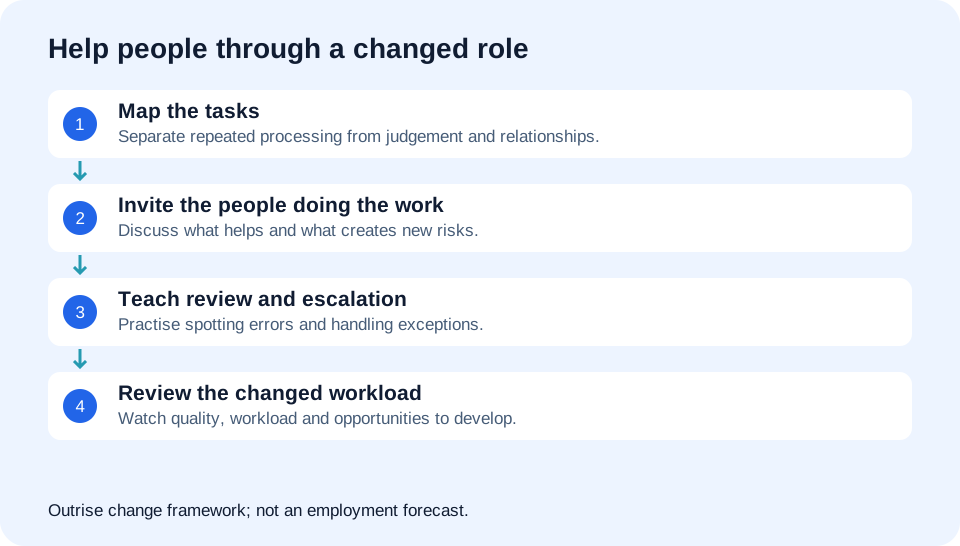
Read the workflow steps
- Map the tasks: Separate repeated processing from judgement and relationships.
- Invite the people doing the work: Discuss what helps and what creates new risks.
- Teach review and escalation: Practise spotting errors and handling exceptions.
- Review the changed workload: Watch quality, workload and opportunities to develop.
Measure more than output
Track whether mistakes are caught, customers get clearer answers and employees understand their responsibilities. Ask whether people have more time for difficult cases or are simply reviewing a larger pile of machine-written drafts.
Honest conversations are part of the work. Explain what is known, which decisions have not been made and how people can contribute. If a role may change, say so clearly. Training should help people adapt to a real change, rather than decorate a decision already made in secret.
ILLUSTRATIVE DISCUSSION
A question you might be asking.
These are example exchanges prepared by Outrise, not comments from visitors.
How do we introduce a tool without making the team feel threatened?
Explain which tasks may change, invite the people doing them into the test and give them time to learn review and escalation. Be honest about decisions still being considered.
JOIN THE CONVERSATION
What does this look like in your business?
Share a practical question or experience. Comments are reviewed before they appear.