
A tool can generate something for a few cents and still be the wrong purchase.
That sounds unfair until you count what happens next: someone checks the output, fixes it, tries again, downloads it, puts it into another application and asks whether it actually reached the customer.
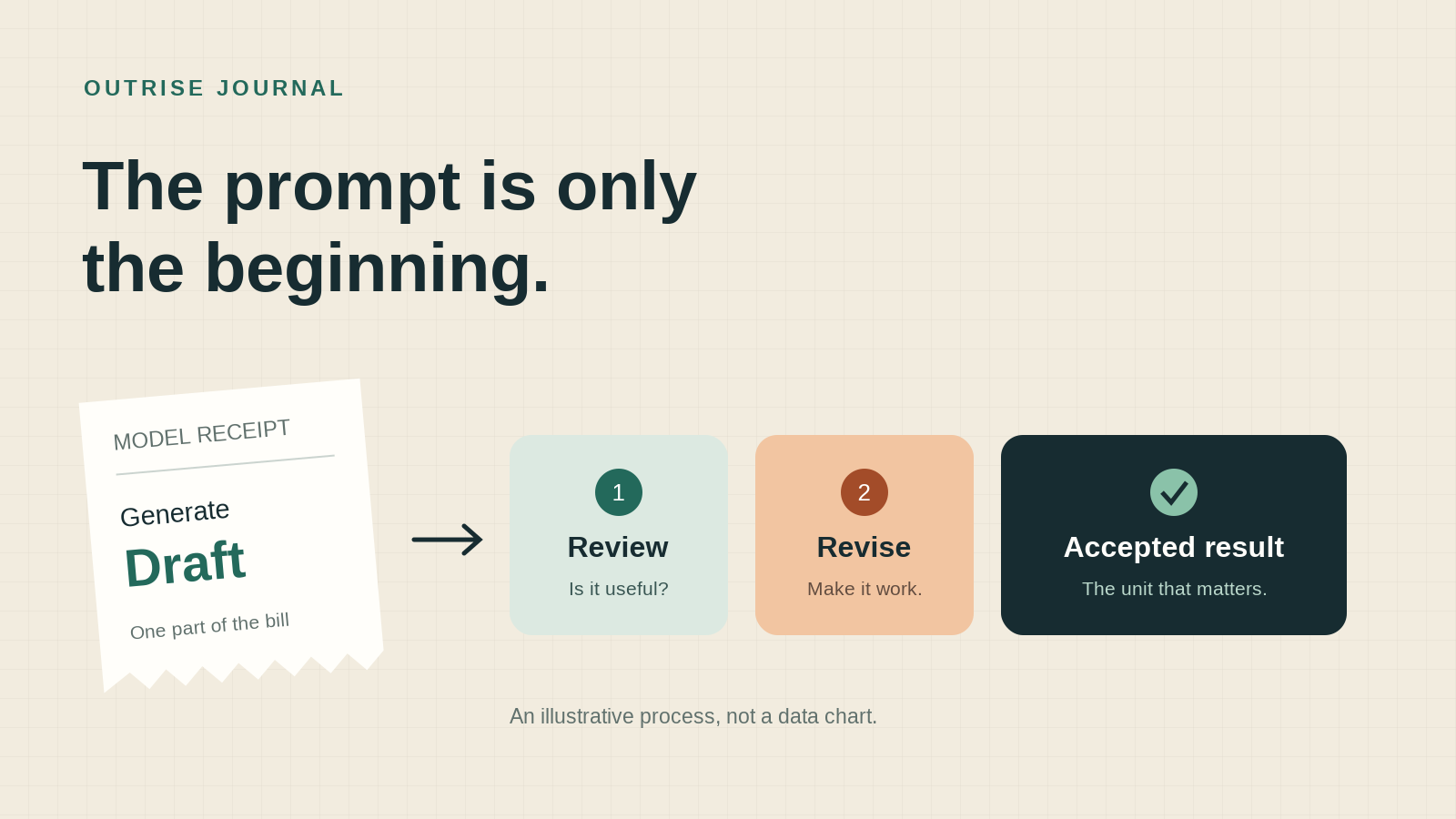
The price on the model page measures one part of the work. Your business pays for the whole job.
The useful unit is an accepted result
Imagine two tools preparing customer replies. This is an illustrative comparison, not an Outrise client result.
Tool A produces 100 drafts for $1. Tool B produces 100 for $3. The first looks cheaper. But suppose A needs much more editing, while B usually follows your instructions. The $2 difference tells you almost nothing about the cost of completing the work.
Try this instead:
Cost per accepted result = generation and running costs ÷ outputs that pass your review.
Then record review time separately. If useful, value that time at your own internal hourly rate and add it to the comparison. Keep that assumption visible: a founder's spare hour and a paid employee's hour are not automatically the same cash expense.
Do not count every draft as a finished result. Define what “accepted” means before testing: accurate facts, useful answer, correct recipient, suitable tone and no unapproved commitment.
What our video pilot actually showed
We recently assembled an internal Outrise explainer with a talking rabbit, narration and original animated booking screens. The first cut needed changes to its pace, middle section and ending. That is a development observation, not evidence of audience success.
The final edit could reuse saved narration and footage. We changed the timing, rebuilt the middle graphics and added locally created music and effects without submitting another media-generation request for those revisions.
The lesson is about process design: make the expensive parts reusable and the editable parts easy to change. It does not establish a universal cost per video, a production-ready publishing system or guaranteed engagement.
That principle also applies to proposals, reports and email drafts. Save approved facts and source material. Separate the substance from its presentation. Avoid regenerating everything because one sentence changed.
Three costs the headline price leaves out
Retries. A provider request can succeed technically while producing something you cannot use. Record both the request outcome and your quality decision. A timeout is another case: check whether the original request finished before paying to submit it again. Fal's queue documentation provides separate status and result checks for long-running jobs. Fal API documentation, checked 19 October 2026.
Running the process. Hosting, storage and model usage are separate line items. Free access may be enough for an experiment but should not be treated as unlimited production capacity. Google's pricing page distinguishes its limited free access from paid API tiers. Check the particular model and your account before planning volume. Gemini API pricing, checked 19 October 2026.
Recovering from failure. Somebody needs to know when a process stops. n8n supports error workflows that can notify an operator when a workflow execution fails. The feature still needs to be configured and tested in your own setup. n8n error handling documentation, checked 19 October 2026.
There is a case for the expensive tool
The cheapest tool can be right for a flexible internal draft. A more expensive service may be worth it when consistency, turnaround or reduced correction matters more. Neither conclusion follows from the subscription price alone.
Run the same small sample through both. Use comparable instructions and record every attempt, including rejected outputs. Compare quality, review time and completed results before committing to a larger plan.
A five-question buying check
- What exact finished task are we paying to complete?
- What makes an output acceptable?
- How many attempts and minutes of review did it take?
- Which parts can we reuse when something changes?
- Who sees a failure, and how do we resume safely?
Buy enough to prove the process. Expand when the evidence supports it.
Which costs your team more today: the AI subscription, or fixing what happens after the first draft?
JOIN THE CONVERSATION
What happens after your first AI draft?
Share a practical question or experience. Comments are reviewed before they appear.