
The task nobody wants to talk about is often the best place to start. Copying form responses. Finding a duplicate. Checking who called a lead. Asking for a missing document. These are not exciting demos, but they are real work.
A first automation project should have a clear beginning and end. If you cannot explain it to a colleague in a few sentences, the scope may already be too large.
Choose a repeated task with a visible result
Start where the input is reasonably consistent and someone can tell whether the output is correct. For a lead pipeline, that might mean receiving an enquiry, cleaning the record, assigning an owner and showing the next step. It does not have to mean an AI system negotiating with customers.
A NBER study of 5,179 customer-support agents found a 14% average improvement in issues resolved per hour with an AI assistant, with 34% for novice and lower-skilled workers in its November 2023 working-paper revision. It is one setting, not an Outrise result or a guaranteed gain. Study and version details.
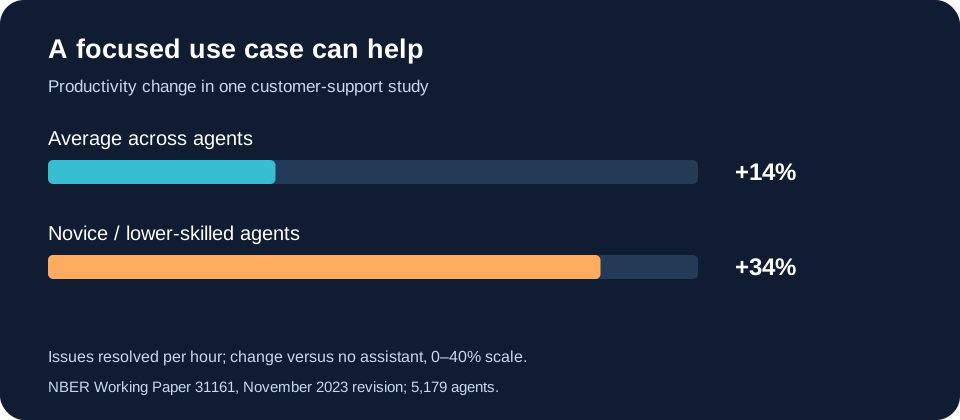
Read the chart values
| Measure | Value |
|---|---|
| Average across agents | +14% |
| Novice / lower-skilled agents | +34% |
The useful lesson is to test a defined task. A broad promise to “transform operations” is much harder to evaluate than a change to a specific queue, response or handoff.
Write down the rules before connecting apps
For each step, record the input, the action, the owner and what happens when something is missing. Agree what each status means. “Interested” and “ready to onboard” should not mean different things to different people.
In Outrise's candidate workflow, form submissions become records in Google Sheets. Gemini-assisted Apps Script removes repeated entries from the working list. A person calls or messages candidates and records their interest. Interested and tentative records move into follow-up; proof collection and final batching follow. The qualification conversation remains human.
That structure can be adapted to business enquiries, quotations or onboarding. The specific rules need to fit the new process. A recruitment status should not simply be copied into a sales pipeline and assumed to mean the same thing.
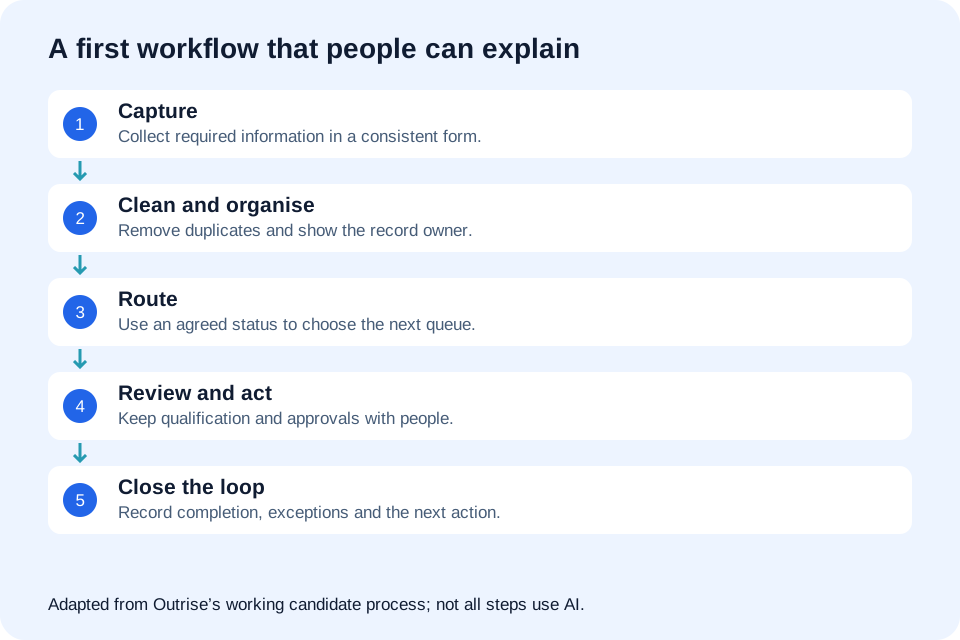
Read the workflow steps
- Capture: Collect required information in a consistent form.
- Clean and organise: Remove duplicates and show the record owner.
- Route: Use an agreed status to choose the next queue.
- Review and act: Keep qualification and approvals with people.
- Close the loop: Record completion, exceptions and the next action.
Use AI only where interpretation helps
- Fixed rule: move a record when an approved status is selected.
- Possible AI assistance: prepare a draft summary from a long message.
- Human judgement: confirm interest, approve a sensitive response or handle an exception.
Keeping these responsibilities separate makes the system easier to explain and repair. If a summary is poor, a person can rewrite it without breaking the record-routing process.
Test ordinary cases and the awkward ones
Try a repeated submission, an incomplete record, a changed status and a failed connection. Check that records are not lost or moved twice. Make the failure visible to someone who can act, and give the team a manual route while the issue is fixed.
Then run a small pilot with a named owner. Record completion time, missed actions and correction work. Include the time spent checking the automation, not just the time it appears to save.
ILLUSTRATIVE DISCUSSION
A question you might be asking.
These are example exchanges prepared by Outrise, not comments from visitors.
Would enquiry follow-up be a sensible starting point for a small business?
Yes, if the input and next action are clear. Begin with capture, ownership and statuses; keep qualification decisions with a person while you test the routing.
JOIN THE CONVERSATION
What does this look like in your business?
Share a practical question or experience. Comments are reviewed before they appear.